
LEAF DISEASES
If your lawn is properly watered and fertilized but still has a yellowish color, it is most likely caused by one or more leaf diseases.There are many beneficial organisms in your lawn, however, there are several harmful ones.
The harmful ones are parasitic forms called fungi. Fungi live in the soil and on infected leaves year-round.
These fungi feed by stealing the nutrients they need from the grass.
The disease spreads through lawns through spores. These spores are spread by wind, air, water, and human foot traffic.
The disease can recur from year to year if favorable circumstances arise again.
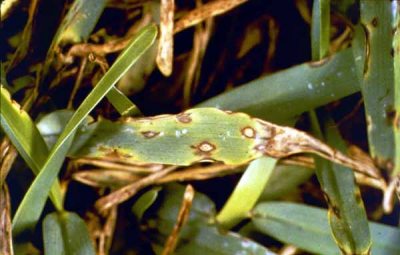
CAUSES OF LEAF DISEASES IN ENGLISH LAWNS
Three factors must be present for leaf spot disease to occur.
There must be a plant, in this case lawn grass, a pathogen, therefore a fungus, and an environment favorable for the disease.
If any of these factors are missing, symptoms of disease will not be present.
Even with all three factors, the disease will not occur unless favorable circumstances continue over a long period of time.
Some of the most common causes of leaf diseases are as follows:
SOME OF THE MOST COMMON LEAF DISEASES
LEAF SPOT (Helminthosproium) - This disease is recognized by small yellow spots with a dark border. These lesions appear over the entire surface of the leaf. The disease develops in hot, humid weather. This disease often occurs on overly mowed lawns.
DOLLAR SPOT (Sclerotinia Homeocarpa) - Sclerotinia Homeocarpa, more commonly known as dollar spot, is a disease that develops in English lawns during warm, humid periods. The fungus infects lawn plants when they are wet. Large, colorful wounds appear on the leaves. The leaf resembles an hourglass. The infected areas form small circles resembling dollar coins. Over time, the various damaged areas will tend to merge together, forming large patches.
LEAF RUST - Leaf rust appears on English lawns during warm, humid periods. The disease particularly affects lawn plants after evening mowing followed by heavy watering at night. In heavily infested areas, the fungus damages the lawn, creating large circular patches. A close inspection of the plant reveals that the leaves die from the tips downwards, with a brownish-purple line running horizontally across the plant.
HOW TO TREAT LEAF DISEASES
An English lawn suffering from leaf diseases is like us when we're cold. There's no treatment that can cure a lawn; we must address the symptoms. And even if we try to minimize the effects, if circumstances continue to favor the disease, it will recur over and over again. The best treatment is to prevent the disease from developing by addressing the conditions that cause it. As explained above, for a disease to develop, it requires a plant, a pathogen, and the right environment for it to thrive. Clearly, the only factor we can change are the circumstances that favor the disease's development. Some tips for modifying these circumstances are the following:
Three factors must be present for leaf spot disease to occur.
There must be a plant, in this case lawn grass, a pathogen, therefore a fungus, and an environment favorable for the disease.
If any of these factors are missing, symptoms of disease will not be present.
Even with all three factors, the disease will not occur unless favorable circumstances continue over a long period of time.
Some of the most common causes of leaf diseases are as follows:
- Long periods of hot and humid weather
- Watering at night or heavy evening rains. Watering in the morning causes excess moisture to evaporate with the heat of the day. Watering at night leaves the grass leaves wet for a long time, creating the ideal environment for the spread of spores.
- Mowing when the lawn is wet promotes the spread of disease spores
- A sharp mower blade makes a clean cut that heals quickly, unlike a dull blade. A dull blade tears the leaf and creates a jagged cut. This takes longer for the leaf to heal, and the jagged cut also promotes the spread of disease spores.
- Mowing too frequently puts stress on the lawn and makes it more susceptible to disease.
- If the plant lacks essential nutrients such as nitrogen, it becomes more vulnerable to disease attack.
SOME OF THE MOST COMMON LEAF DISEASES
LEAF SPOT (Helminthosproium) - This disease is recognized by small yellow spots with a dark border. These lesions appear over the entire surface of the leaf. The disease develops in hot, humid weather. This disease often occurs on overly mowed lawns.
DOLLAR SPOT (Sclerotinia Homeocarpa) - Sclerotinia Homeocarpa, more commonly known as dollar spot, is a disease that develops in English lawns during warm, humid periods. The fungus infects lawn plants when they are wet. Large, colorful wounds appear on the leaves. The leaf resembles an hourglass. The infected areas form small circles resembling dollar coins. Over time, the various damaged areas will tend to merge together, forming large patches.
LEAF RUST - Leaf rust appears on English lawns during warm, humid periods. The disease particularly affects lawn plants after evening mowing followed by heavy watering at night. In heavily infested areas, the fungus damages the lawn, creating large circular patches. A close inspection of the plant reveals that the leaves die from the tips downwards, with a brownish-purple line running horizontally across the plant.
HOW TO TREAT LEAF DISEASES
An English lawn suffering from leaf diseases is like us when we're cold. There's no treatment that can cure a lawn; we must address the symptoms. And even if we try to minimize the effects, if circumstances continue to favor the disease, it will recur over and over again. The best treatment is to prevent the disease from developing by addressing the conditions that cause it. As explained above, for a disease to develop, it requires a plant, a pathogen, and the right environment for it to thrive. Clearly, the only factor we can change are the circumstances that favor the disease's development. Some tips for modifying these circumstances are the following:
- Avoid watering at night
- Avoid mowing in the evening or at night
- Keep the cutting height between 5 and 8 centimetres
- Make sure the lawnmower blade is kept sharp
- A healthy lawn is the best defense against disease, so it needs to be fertilized regularly.
- Beyond our control are the optimal climatic conditions that will help the lawn to cope with leaf diseases to a greater extent.