
Powdery mildew (Erysiphe graminis)
Powdery mildew is a plant parasite from the fungus family. The fungi live in the soil and on infected leaves year-round, drawing nutrients from the lawn.Powdery mildew, also known as powdery mildew, is a disease that attacks plants and lawn leaves.
Periods with very poor air circulation favor this disease.
Shaded areas are particularly susceptible.
The disease is particularly strong in spring and autumn with temperatures ranging from 15 to 22°C, however it develops in a temperature range from 1 to 30°C.
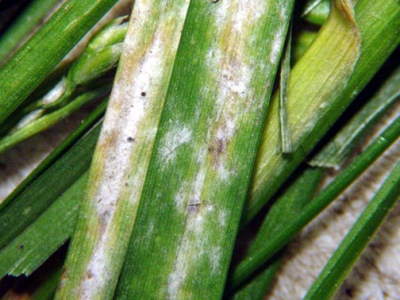
HOW TO RECOGNIZE POWDERY MILDEW
Symptoms of powdery mildew or Oidium include the following:
HOW TO TREAT POWDERY MILDEW
The best treatment for powdery mildew is to change some of the practices that are favoring the conditions for this disease to spread.
As long as circumstances remain favorable, powdery mildew will continue to infect the grass leaves and if this continues for long periods the damage will become permanent.
Below you will find some tips on what to avoid and what to do to prevent powdery mildew:
Symptoms of powdery mildew or Oidium include the following:
- Early stages of powdery mildew are recognized as isolated colonies of whitish fungal structures called mycelia that appear on leaves.
- The mycelia colonize and infect a large portion of the leaf with a whitish and gray powdery mold.
- Older leaves are more infected than younger leaves
- Heavily infected leaves may turn yellow-brown and then die. Powdery mildew colonies darken over time.
- Infected plants become weakened and susceptible to other problems.
HOW TO TREAT POWDERY MILDEW
The best treatment for powdery mildew is to change some of the practices that are favoring the conditions for this disease to spread.
As long as circumstances remain favorable, powdery mildew will continue to infect the grass leaves and if this continues for long periods the damage will become permanent.
Below you will find some tips on what to avoid and what to do to prevent powdery mildew:
- Increase air circulation and light penetration through trees and shrubs through good pruning
- Overseed your lawn with seed that is more shade-tolerant.
- Increase the cutting height to 6-8 centimetres high.
- Water abundantly and do not subject the lawn to water stress
- Improve drainage to increase water absorption at the root zone and increase air circulation. Good aeration is recommended for this purpose.
- Don't water at night. Water left on the lawn overnight encourages the spread of the disease.
- Provide the right amount of fertilizer and avoid excess nitrogen, which encourages the spread of the disease. A slow-release granular fertilizer can provide the right amount of nitrogen for a long period.